Introduction
Food patterns and consumption practices are intrinsic components of population groups across the world. Those dietary practices are influenced by the physical environment, particularly those products identified as edibles, but also by the cultural practices that define people. Extensive research indicates that food patterns play substantial roles in the causation and prevention of chronic, non-communicable diseases (1) and that the food environment, including access to food outlets and the presence of healthy choices, is associated with eating behaviors (2, 3). It has been shown that shopping preferences are linked to obesity and that the lack of healthy food options in grocery stores leads to weight-gain (4). Successful policies should also be part of a larger plan to change social norms (5). In response to this challenge, the Nutrition Environment Measures Survey for Stores (NEMS-S) was developed in the first decade of the millennium as a well-defined measurement tool to examine the availability of healthy food options in grocery and convenience stores in the United States (6). We refer to this original instrument as US-NEMS-S
Cultural factors play a significant role in determining shopping preferences, as food-related behavior is modified by culture (7, 8). Ethnic identity is positively correlated with consumption of culturally-significant foods and negatively correlated with the consumption of ‘convenience’ or prepackaged foods (9). Stores targeted to specific ethnic groups, including Latinos, serve as important sites for the preservation of their homeland culture (10), including their food preferences.
Despite the significance of culture in shaping food preferences, current research lacks a culturally-specific analysis of what drives food preferences, specifically for the growing Latino population, particularly recent arrivals of Central Americans (Guatemalans, Hondurans and Salvadorians) in the northeast region of the United States . The present study aimed to contribute with information to help to fill this gap in knowledge by assessing the applicability of the NEMS-S survey modified for use in Guatemala (11) as compared to the original US-NEMS-S, which wa, both in its original version designed for the US population, and as modified for use in Guatemala (11). The site identified for this study was Somerville, a small city located north of Boston, state of Massachusetts.
The Guatemala NEMS-S (GUA-NEMS-S) survey contained items more familiar in a Latino diet, including selected fruits and vegetables, canned beans and boxed fluid milk. Researchers believed that the conduct of the GUA-NEMS-S would result in a more thorough analysis of the availability of healthy and unhealthy foods in stores in Latino communities in the US because the items on the survey would match those being sold in these culturally specific stores.
The primary objective of this study was to test the GUA-NEMS-S to examine the food environment in a convenient, small sample of Latino stores, located in East Somerville, in which there is a rapidly growing Latino population, primarily of Central American origin. Secondarily, researchers also utilized the NEMSS surveys to assess the availability of healthy food options in the three Latino stores. The corresponding hypotheses were: 1) The foods found in the three Latino stores will apply more closely to the GUA-NEMSS than the original survey created for US stores (US-NEMS-S); and 2) There will be a general lack of healthy food options in these small stores indicated by the results of the NEMS-S surveys.
Material and methods
- ENUMERATION
- UTILIZATION OF NEMS-S
- INTER-RATER CONCORDANCE
- ANALYSIS OF FOOD ITEM AVAILABILITY
Results
- STORE LAYOUT
- INTER-RATER CONCORDANCE ON THE ITEMS OF THE US-NEMS-S VERSION
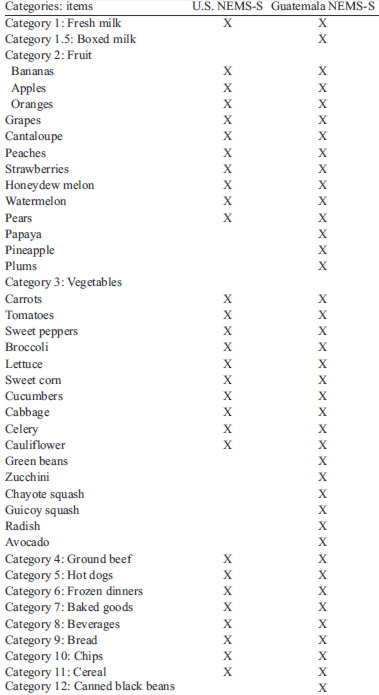
TABLE 1: Categories and items in the U.S. NEMS-S compared to the Guatemala NEMS-S
- INTER-STORE COMPARISON OF COMMON ITEMS BETWEEN SURVEYS
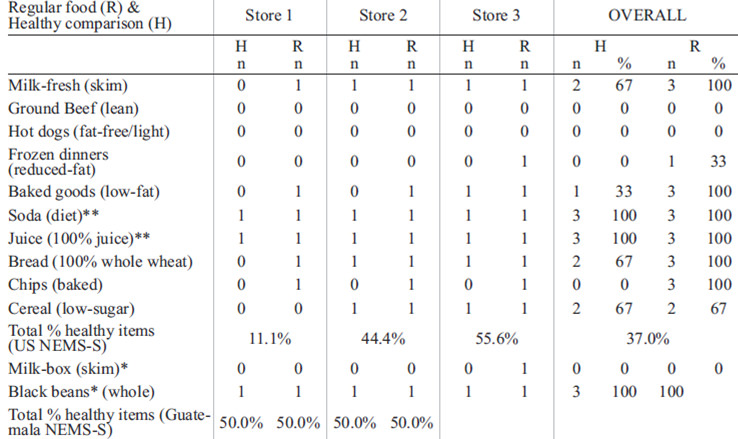
As there was 100% inter-rater concordance between raters for the 29 common items, there was a redundant certainty of the status of these items across store sites. This allowed the analysis of all of the items (none were in dispute) for inter- store analysis. Table 2 (non-produce items) and Table 3 (produce items) present the pooled results found in each store regarding the availability of items included in both, the US-NEMSS and the GUA-NEMS-S.
TABLE 2. Regular and healthy food availability of U.S. NEMS-S and Guatemala NEMS-S across three different Latino stores
* Based on Guatemala NEMS-S only
**Soda and Juice are considered to be one singular item “beverages” for calculations (as seen on the NEMS-S surveys).
TABLE 3. Fruit and vegetable availability of U.S. NEMS-S and Guatemala NEMS-S across three different Latino stores
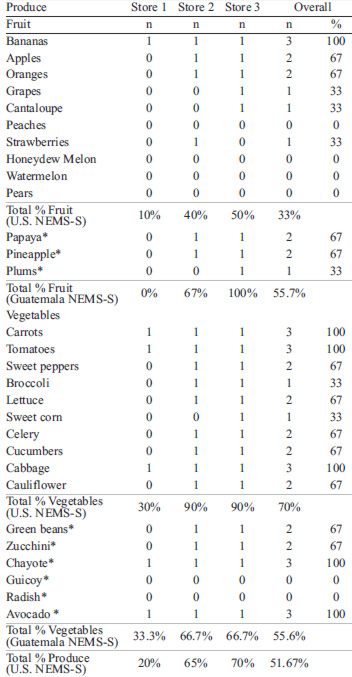
Total % Produce (U.S. NEMS-S) 20% 65% 70% 51.67%
* Based on Guatemala NEMS-S only
- INTER-STORE COMPARISON OF HEALTHY OPTIONS OF THE US-NEMS-S ACROSS THE COMBINED SURVEYS
- RELATIVE AVAILABILITY OF THE ADDITIONAL GUATEMALAN ITEMS AMONG THE THREE FOOD STORES
Discussion
- INTER-RATER CONCORDANCE
- HEALTHY FOOD AVAILABILITY ACROSS STORES
- PERFORMANCE OF THE GUATEMALAN ADAPTATION OF THE NEMS-S
- COMPARISON WITH NEMS-S APPLICATIONS OUTSIDE OF THE DOMINANT U.S. CULTURE
- STRENGTHS AND LIMITATIONS OF THE STUDY
Conclusions
The results of this study highlight the importance of attending to the cultural characteristics of the diverse population groups that are more inclined to do their food shopping in small, ethnic stores such as those frequented by Latinos.
In the middle of the current epidemic of obesity and non-communicable diseases associated with eating patterns, it is needed to encourage and support owners of Latino stores to offer more ethnic specific healthy options of the traditional Latino food products.
Additionally, in the future, a second generation of culturally-sensitive NESM-S, that substitutes foods of a more tropical and Central American origin in the listing, rather than simply adding them on, will need to be developed and tested in a similar context and paradigm as the one that gave the cultural framework to this study.
References
- Drewnowski A. Obesity and the food environment: dietary energy density and diet costs. Am J Prev Med 2004;27(3):154-162.
- Babey SH, Diamant AL, Hastert TA, Harvey S. Designed for disease: the link between local food environments and obesity and diabetes. UCLA Center for Health Policy Research, 2008.
- Drewnowski A, Rolls BJ. How to modify the food environment. J Nutr 2005;135(4):898-899.
- Story M, Kaphingst KM, Robinson-O'Brien R, Glanz K. Creating healthy food and eating environments: policy and environmental approaches. Annu Rev Public Health 2008;29:253-272.
- Graff SK, Kappagoda M, Wooten HM, McGowan AK, Ashe M. Policies for healthier communities: historical, legal, and practical elements of the obesity prevention movement. Annu Rev Public Health 2012;33:307-324.
- Glanz K, Sallis JF, Saelens BE, Frank LD. Healthy nutrition environments: concepts and measures. Am J Health Promot 2005;19(5):330-333.
- Asp EH. Factors affecting food decisions made by individual consumers. Food Policy 1999;24(2):287-294.
- Kumanyika SK. Environmental influences on childhood obesity: ethnic and cultural influences in context. Physiol Behav 2008;94(1):61-70.
- Laroche M, Kim C, Tomiuk MA. Italian ethnic identity and its relative impact on the consumption of convenience and traditional foods. J Consum Mark 1998;15(2):125-151.
- Mankekar P. 'India Shopping': Indian grocery stores and transnational configurations of belonging. Ethnos 2002;67(1):75-97.
- Kanter R, Alvey J, Fuentes D. A novel mobile phone application to assess nutrition environment measures in low-and middle-income countries. Food Nutr Bull 2014;35(3):296-300.
- Chasan E, Pistran D, Santos E, Salazar B. The Latino Business Community in Somerville, Mass. Urban Borderlands. https://sites.tufts.edu/urbanborderlands/about-urban-borderlands/. 2003.
- Nutrition Environment Measures Survey. www.med.upenn.edu/nems. Updated 20132015.
- Kanter R, Alvey J, Fuentes D, et al. The Nutrition Environment Measurement Survey-Stores in Guatemala: measurement performance between the standard (USA) and a modified version (1019.7). FASEB J 2014;28(1 Supplement):1019.7.
- Rimkus L, Powell LM, zenk SN, et al. Development and reliability testing of a food store observation form. J Nutr Educ Behav 2013;45(6):540-548.
- Glanz K, Sallis JF, Saelens BE, Frank LD. Nutrition Environment Measures Survey in stores (NEMS-S): development and evaluation. Am J Prev Med 2007;32(4):282-289.
- Krukowski RA, West DS, Harvey-Berino J, Prewitt TE. Neighborhood impact on healthy food availability and pricing in food stores. J Community Health 2010;35(3):315-320.
- Satia-Abouta J, Patterson RE, Neuhouser ML, Elder J. Dietary acculturation: applications to nutrition research and dietetics. J Am Diet Assoc 2002;102(8):1105-1118.
- Ayala GX, Baquero B, Klinger S. A systematic review of the relationship between acculturation and diet among Latinos in the United States: implications for future research. J Am Diet Assoc 2008;108(8):1330-1344.
- Powell LM, Slater S, Mirtcheva D, Bao Y, Chaloupka FJ. Food store availability and neighborhood characteristics in the United States. Prev Med 2007;44(3):189-195.
- Andreyeva T, Blumenthal DM, Schwartz MB, Long MW, Brownell KD. Availability and prices of foods across stores and neighborhoods: the case of New Haven, Connecticut. Health Aff (Millwood) 2008;27(5):1381-1388.
- Gartin M. Food deserts and nutritional risk in Paraguay. Am J Hum Biol 2012;24(3):296-301.
- Martins PA, Cremm EC, Leite FH, Maron LR, Scagliusi FB, Oliveira MA. Validation of an adapted version of the nutrition environment measurement tool for stores (NEMS-S) in an urban area of Brazil. J Nutr Educ Behav 2013;45(6):785-792.
- Anderson Steeves, E, Martins PA, Gittelsohn J. Changing the Food Environment for Obesity Prevention: Key Gaps and Future Directions. J. Curr Obes Rep 2014;3(4):451-458.