Introduction
Investigating factors that influence blood lipid concentrations is of great interest, referring especially to the impact of food habits on biochemical profile. Meal frequency appears to be associated to lipid concentrations: both adults (1, 2) and children (3) who have daily higher meal frequency seem to present better biochemical profile (low levels of total cholesterol and LDL). Breakfast particularly seems to play a key role in influencing blood lipids: adults (4) and children (5) who report to eat breakfast regularly show better biochemical profiles than those who skip breakfast. Referring, more specifically, to the effect of food consumption on lipid profile, junk food consumption among adults is related to higher lipids concentrations (6). In addition, it is demonstrated (7, 8) that children who eat processed food and food containing saturated fat present higher blood lipids concentrations. Understanding the impact of food habits on blood lipids profile is important, especially in the context of childhood obesity, because several studies (9-12), investigating blood lipid profile among school children, find out higher lipid concentrations among overweight and obese children compared to normal weight ones. Biochemical impairments in children (especially in those overweight/obese) could lead to the early onset of atherosclerotic process and metabolic alterations (impaired glucose tolerance, high concentrations of inflammatory biomarkers) resulting in higher risk of developing cardiovascular and endocrine diseases in early adulthood. Given the increased risk of cardiovascular and metabolic diseases, biochemical alterations in obese children represent a concerning public health burden, worsened by the high prevalence of overweight and obesity in both industrialized and emerging countries: the NHANES investigation (13), conducted between 2011 and 2012 among US population, shows that 34.2% of children (6-11 years of age) were overweight or obese in accordance to CDC growth standards (14) . Similar rates are reported from the ENSANUT survey (15) (conducted among Mexican population in 2012), showing a prevalence of overweight and obesity among Mexican school children (5-11 years of age) of 34.4%.
Therefore it’s crucial to characterize blood lipid profiles among overweight/obese children (especially among Latino ones who seem to be more prone to metabolic impairments compared to other ethnic groups (16)), investigating factors that play a key role in determining lipid concentrations in order to orientate health care policies.
This study aims to investigate socio-economic characteristics, food habits and blood lipid profile among school children in the city of Montemorelos (a low income living area located in Mexico), characterizing lipid concentrations among overweight/obese children and evaluating the impact of socio-economic features and food habits in influencing lipid profile among these children.
Materials and methods
This cross sectional study is based on data from a survey conducted in school children of 19 school facilities in the city of Montemorelos (Nuovo Leon, Mexico). The aim of the study was to investigate socio-economic characteristics, eating habits, anthropometric data and blood’s lipid profile of the enrolled children. Children were eligible for the study if they attended the fifth school grade (10-11 years of age). Their parents were asked to complete an informed consent document before the enrollment. Complete data were available for 156 children (78 boys and 78 girls). The instrument used for data collection was adapted from the one previously used in the enKid study (17) on Spanish children. Mothers were asked to fill the questionnaire.
Socio-economic characteristics
Socio-economic characteristics regarded parents’ working status (worker and housewife for mothers, intellectual and manual worker for fathers), educational level (considered as low, referring to primary education, and mediumhigh, referring to secondary and post-secondary education) and living conditions (house of property, house for rent or council house)
Eating habits
Eating habits are represented by weekly food consumption, meal frequency, breakfast consumption and mealtime characteristics (distractions at mealtime, with whom children have meals, where children have meals outside home). Food consumption was classified using the three food groups (grains and tubers, fruits and vegetables, animal source food and legumes) indicated from “el Plato del Bien Comer” (established from the official Mexican norm NOM 043-SSA2-2005 (18)). In order to classify all the food types reported in the questionnaire, we considered a further food group including fats and sweets. The classification is based on the nutritional values of the food included in every food group: fruits and vegetables are a source of vitamins and minerals, diary and animal food source content proteins, grains and tubers bring carbohydrates and vitamins. Beverages were classified separately from food, including milk, soft drinks, fruit juices, coffee and tea and licuados (a traditional Latin American beverage made of milk and fruit, sometimes added with sugar, honey, oat or ice).
Anthropometric measurements and blood lipid profile
Anthropometric measurements were performed by trained researchers in a room provided by every school facility involved in the study. Height and weight were measured while children were barefoot and wearing light clothes. BMI (Kg/m2) was calculated as weight (kg) divided by height (m) squared. Children were classified to be overweight/obese with a BMI ≥85 percentiles, as recommended by CDC growth standards (14).
Venous blood samples were collected after an overnight fast. The collection of blood samples was performed by three trained laboratory technicians from 7:00 a.m. to 8:00 a.m. in a dedicated room of the same school facilities attended from children enrolled in the study. Blood samples were stored in special containers to maintain proper conditions until the analysis and transported to the laboratory of the “La Carlota” hospital where the biochemical analyses were performed. Glucose, total cholesterol, HDL cholesterol and TAG concentrations were determined using the Reagent Set, Pointe Scientific, Inc. Michigan, U.S.A.
Statistical analyses
Descriptive statistics report continuous data as median [I and III quartiles] and categorical data as percentages (absolute number).
The role played by each factor potential influencing the concentration of total cholesterol, HDL, LDL, triglycerides and glucose was estimated using Random Forest, consisting in 500 bootstrap replication of the classification and regression tree. Statistical analyses were performed using R system (19) and random forest library (20).
Results
Sample characteristics are summarized in Table 1. Children attend the fifth school grade (10-11 years of age). Most of children watch television more than 3 hours every day. Regarding eating habits, the number of fats and sweets’ servings per week is higher than the number of servings of animal source food and legumes, grains and tubers, fruits and vegetables. Additionally, children drink the same number of weekly servings of milk and soft drinks. Referring to meal frequency, despite the fact that the majority of children have breakfast every day, most of them are reported to have only 2 meals per day. This could be related to the fact that enrolled children do not have lunch or dinner, but we could also hypothesize that this result depends on a misunderstood meal definition (indicating as an occasion of food consumption) conducting mothers to do not consider breakfast as a meal occasion and counting only lunch and dinner. However, we do not investigate specifically if children have lunch and dinner every day.
TABLE 1. Sample characteristics. Continuous data are median [I and III quartiles], categorical data are percentages (absolute number).
![TABLE 1. Sample characteristics. Continuous data are median [I and III quartiles], categorical data are percentages (absolute number).](https://www.alanrevista.org/storage/articles/1279/1770242275_1.jpg)
In accordance to the CDC growth standards (14), 37.8% of children are overweight or obese. Comparing normal weight and overweight/ obese children (Table 2), we find out significant higher concentrations of total cholesterol, HDL, LDL and triglycerides in children overweight/obese. However, glucose concentration was higher in normal weight children, this probably because blood sugar concentration could depend on other factors above body weight. TABLE 2. Blood lipid profile in accordance to normal weight and overweight/obese children. Data are median [I and III quartiles]![TABLE 2. Blood lipid profile in accordance to normal weight and overweight/obese children. Data are median [I and III quartiles]](https://www.alanrevista.org/storage/articles/1279/1770242288_2.jpg)
Figures from 1 to 5 show the role played from socio-economic factors and eating habits (sorted from the highest to the lowest score) in influencing concentrations of total cholesterol, HDL, LDL, triglycerides and glucose. Results demonstrate that eating habits, referring to food and beverage consumption particularly, influence blood’s lipid profile the most. FIGURE 1. Distribution of factors associated with total cholesterol in overweight/obese children. FIGURE 2. Distribution of factors associated with HDL in overweight/obese children. FIGURE 3. Distribution of factors associated with LDL in overweight/obese children. FIGURE 4. Distribution of factors associated with triglycerides in overweight/obese children. FIGURE 5. Distribution of factors associated with glucose in overweight/obese children.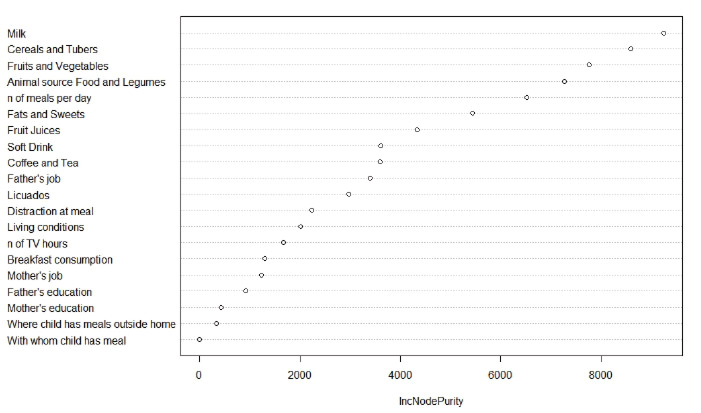
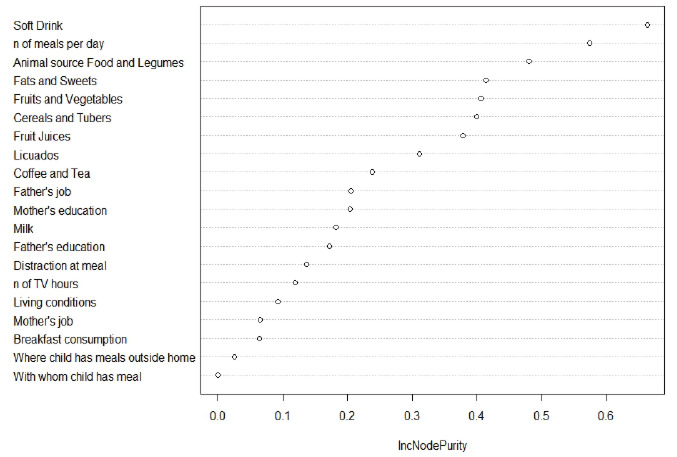
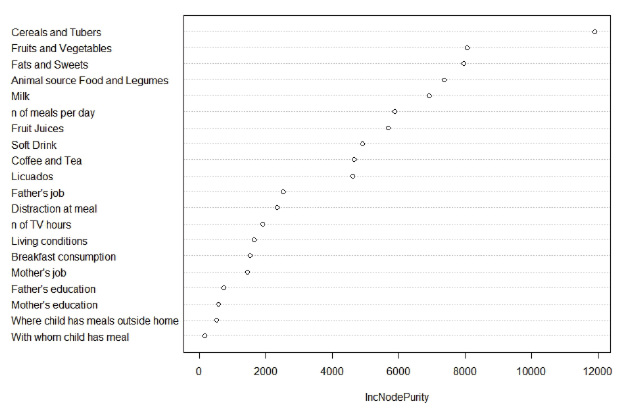
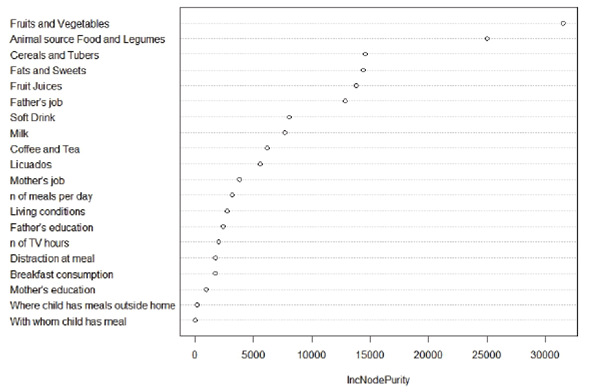
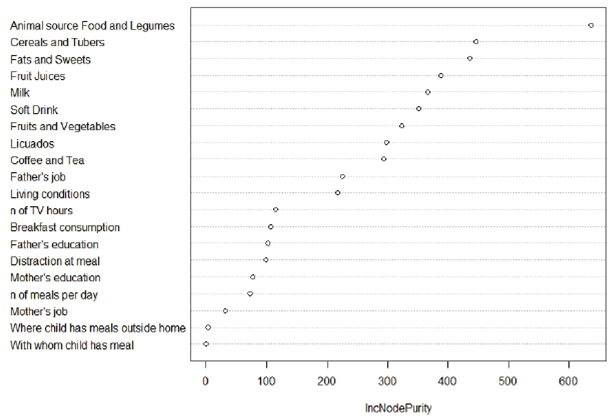
Figures show that the consumption of fruit and vegetables, animal source food and legumes, grains and tubers, fats and sweets and beverages, along with the number of meals per day, play a key role in influencing lipid concentrations. The weight of each type of food and beverage consumption differentiates little considering lipid concentrations one by one. Milk is reported to impact the most among total cholesterol, that’s probably due to a high consumption of whole milk, despite guidelines for Mexican population recommend consumption of low fat milk for children over 2 years of age (21). Also HDL is influenced the most by beverage consumption, represented by soft drinks, along with daily meal frequency. Animal source food influences both glucose and triglycerides, while the latter is influenced also by fruits and vegetables consumption. The impact of breakfast consumption, meal characteristics and socio-economic factors is less important than food consumption among all the investigated lipid concentrations.
Discussion
This study is based on a survey conducted in schoolchildren of Montemorelos (a geographical area located in the north of Mexico). It aimed to investigate eating habits, socio-economic status and blood lipid profiles of children living in the city of Montemorelos, characterizing lipid concentrations among normal weight and overweight/obese children and assessing the impact of socio-economic factors and food habits in influencing blood lipid concentrations (total cholesterol, HDL, LDL, triglycerides, glucose) of overweight/obese kids.
Consistently with other studies conducted in US (22) and in Mexican population (23), we found out higher weekly consumption of fats and sweets compared to fruit/vegetables, animal source food/legumes, grains/tubers, despite the efforts of Mexican government to promote an healthy diet based on the consumption of the three food groups recommended from “el Plato del Bien Comer” (10). Additionally, in accordance to CDC growth standards (14), the prevalence of children overweight or obese is 37.8%, which is barely higher than the prevalence of overweight and obesity in Mexican schoolchildren (15) (34.4% among boys and girls from 5 to 11 years old). This higher prevalence of obesity and overweight is probably related to the fact that the living area of Montemorelos presents unique characteristics: the population living in this area is reported from the local health units to be at high risk of chronic and infectious diseases due to low socioeconomic status, inadequate eating habits and living conditions.
Referring to blood lipid concentrations, we found out higher lipid concentrations in children overweight or obese. These results were reported also from other studies (9-12) which demonstrated that obese children present higher lipid concentrations that could lead to early development of atherosclerotic process and of metabolic abnormalities with consequently higher risk of developing complications in early adulthood (cardiovascular and metabolic diseases particularly), highlighting the need of public policies preventing overweight and obesity in childhood.
Investigating the impact of eating habits and socio-economic factors on blood lipid concentrations, we demonstrated the key role of food and beverage consumption in influencing the lipid profile. Other studies (7, 8) showed the importance of food intake in determining high lipid concentrations, founding out especially a significant correlation of processed food and saturated fat consumption with lipoprotein concentrations. Additionally, we found out that also daily meal frequency play a key role in impacting lipoprotein concentrations, especially regarding HDLcholesterol, in accordance to other studies demonstrating that higher meal frequency is related to better lipid profiles (1-3). However random forest does not specify the type of relationship (positive or negative) between the influencing factors (eating habits and socioeconomic characteristics) and the outcomes (lipid concentrations), this approach shows only the weight of each factor in influencing the outcomes.
Conclusions
Our study demonstrated a higher prevalence of children overweight or obese compared to Mexican schoolchildren general population, additionally we reported higher blood lipid concentrations among these children, founding out that food and beverage consumption play a key role in influencing lipids profile. From these observations evolved the need of developing health care policies promoting healthy eating habits and physical activity among schoolchildren and their families taking into account the unique characteristics of the population living in this specific geographical area of Mexico.
Source of funding
The work has been partially supported by an unrestricted grant from the Italian Ministry of Foreign Affairs under the programs “Programmi di alta rilevanza scientifica e tecnologica” Italia-Messico and Italia-Argentina, and from Prochild ONLUS (Italy).
References
- Titan SM, Bingham S, Welch A, Luben R, Oakes S, Day N, et al. Frequency of eating and concentrations of serum cholesterol in the Norfolk population of the European prospective investigation into cancer (EPIC-Norfolk): cross sectional study. BMJ. 2001;323(7324):1286.
- Smith KJ, Blizzard L, McNaughton SA, Gall SL, Dwyer T, Venn AJ. Daily eating frequency and cardiometabolic risk factors in young Australian adults: cross-sectional analyses. Br J Nutr. 2012;108(6):1086.
- Murakami K, Livingstone MBE. Associations of eating frequency with adiposity measures, blood lipid profiles and blood pressure in British children and adolescents. Br J Nutr. 2014;111(12):2176-83.
- Farshchi HR, Taylor MA, Macdonald IA. Deleterious effects of omitting breakfast on insulin sensitivity and fasting lipid profiles in healthy lean women. Amer J Clin Nutr 2005;81(2):388-96.
- Freitas Júnior IF, Christofaro DG, Codogno JS, Monteiro PA, Silveira LS, Fernandes RA. The association between skipping breakfast and biochemical variables in sedentary obese children and adolescents. The Journal of pediatrics. 2012;161(5):871-4.
- Bogl L, Pietiläinen K, Rissanen A, Kangas A, Soininen P, Rose R, et al. Association between habitual dietary intake and lipoprotein subclass profile in healthy young adults. Nutr Metab Cardiovasc Dis. 2013;23(11):1071-8.
- Rauber F, Campagnolo P, Hoffman D, Vitolo M. Consumption of ultra-processed food products and its effects on children’s lipid profiles: A longitudinal study. Nutr Metab Cardiovasc Dis. 2014.
- Rinaldi AEM, de Oliveira EP, Moreto F, Gabriel GFCP, Corrente JE, Burini RC. Dietary intake and blood lipid profile in overweight and obese schoolchildren. BMC Res Notes. 2012;5(1):598.
- Friedland O, Nemet D, Gorodnitsky N, Wolach B, Eliakim A. Obesity and lipid profiles in children and adolescents. J Pediatr Endocrinol Metab. 2002;15(7):1011-6.
- Garcés C, Gutierrez-Guisado J, Benavente M, Cano B, Viturro E, Ortega H, et al. Obesity in Spanish schoolchildren: relationship with lipid profile and insulin resistance. Obes Res. 2005;13(6):959-63.
- Lima SC, Arrais RF, Almeida MG, Souza ZM, Pedrosa LF. Plasma lipid profile and lipid peroxidation in overweight or obese children and adolescents. J Pediatr (Rio J). 2004;80(1):23-8.
- Maximova K, Kuhle S, Davidson Z, Fung C, Veugelers PJ. Cardiovascular Risk-Factor Profiles of Normal and Overweight Children and Adolescents: Insights From the Canadian Health Measures Survey. Can J Cardiol. 2013;29(8):976-82.
- Ogden CL, Carroll MD, Kit BK, Flegal KM. Prevalence of childhood and adult obesity in the United States, 2011-2012. JAMA. 2014;311(8):806-14.
- Kuczmarski RJ, Ogden CL, Grummer-Strawn LM, Flegal KM, Guo SS, Wei R, et al. CDC growth charts: United States. Adv Data. 2000(314):1-27.
- Gutierrez JP, Rivera-Dommarco J, Shamah-Levy T, Villalpando-Hernández S, Franco A, Cuevas-Nasu L, et al. Encuesta nacional de salud y nutrición 2012. Resultados Nacionales Cuernavaca, México: Instituto Nacional de Salud Pública. 2012.
- Davis JN, Ventura EE, Weigensberg MJ, Ball GD, Cruz ML, Shaibi GQ, et al. The relation of sugar intake to β cell function in overweight Latino children. Amer J Clin Nutr. 2005;82(5):1004-10.
- Serra-Majem L, García-Closas R, Ribas L, Pérez-Rodrigo C, Aranceta J. Food patterns of Spanish schoolchildren and adolescents: The enKid Study. Public Health Nutr. 2001;4(6a):1433-8.
- Norma Oficial Mexicana: NOM-043-SSA2-2005, Servicios básicos de salud. Promoción y educación para la salud en materia alimentaria. Criterios para brindar orientación.
- Team RC. R: A language and environment for statistical computing. R Foundation for Statistical Computing, Vienna, Austria. 2013. ISBN 3-900051-07-0; 2014.
- Liaw A, Wiener M. Classification and Regression by randomForest. R news. 2002;2(3):18-22.
- Rivera JA, Muñoz-Hernández O, Rosas-Peralta M, Aguilar-Salinas CA, Popkin BM, Willett WC. Consumo de bebidas para una vida saludable: recomendaciones para la población mexicana. Bol Med Hosp Infant Mex. 2008;65(3):208-37.
- Munoz KA, Krebs-Smith SM, Ballard-Barbash R, Cleveland LE. Food intakes of US children and adolescents compared with recommendations. Pediatrics. 1997;100(3):323-9.
- Jiménez-Cruz A, Bacardı́-Gascón M, Jones EG. Consumption of fruits, vegetables, soft drinks, and high-fat-containing snacks among Mexican children on the Mexico-US border. Arch Med Res. 2002;33(1):74-80.